Saturday, January 17, 2015

#NoNewFriends...Okay...Maybe a Few.

“What you mean I was the class clown?!”. All is revealed in the car trip to the Toco coastline, when my father reminds me that this is the descriptor my school principal gave of me circa 2003; my principal, the humbly pleasant but stern woman who we were journeying to look for, because I wanted to tell her thank you, whether or not she remembered the favor. She had many years ago, scooped me up from a lunch gathering, me mid-laughter, the kind you have to contort into a throaty cough to dissolve it from your face.


She did not know me. I mean of course she knew my name, she knew what horrendous grades I made in her Spanish class one term, but she also did not hesitate to let me know that the group of friends I had been keeping, was probably not the right fit for me. She told me that I could do better on all fronts, that I had immense potential as a student and I was wasting away because I was not taking the opportunity of being there (there: a good school with tremendous room for growth and learning) seriously enough. She did not know me.


How could she have possibly been so right then?


I’ve been between Trinidad and New York a number of times within the last year, and for me this is only the beginning of transnational living as an adult on my own terms, booking (and recently mis-booking) my own flights, and for once not feeling like I belong in any one place more than the other. I’ve somehow managed to find equilibrium in this previously chaotic situation, possibly because I’ve made peace with the way things are. I’m more accepting of what life gives and takes away.

Toco stop on the hill.


One of the most interesting navigations for me centers on friendships and relations outside of family. Possibly because these relationships are forever being negotiated between parties involved. I reflect on Keith Basso’s anthropological study of Western Apache cultural practice, where silence is used in particular social situations, one of these being between parents and children, when the child returns from school abroad.


“Apache parents openly admit that, initially, children who have been
away to school seem distant and unfamiliar. They have grown older, of
course, and their physical appearance may have changed. But more fundamental
is the concern that they have acquired new ideas and expectations
which will alter their behavior in unpredictable ways. No matter how pressing
this concern may be, however, it is considered inappropriate to directly
interrogate a child after his arrival home. Instead, parents anticipate that
within a short time he will begin to divulge information about himself that
will enable them to determine in what ways, if any, his views and attitudes
have changed. This, the Apache say, is why children do practically all the
talking in the hours following a reunion, and their parents remain unusually silent.” 1


This puts much into perspective for me. There are folks who I can no longer have extensive conversations with. Simply because we have grown in different directions, have different priorities, value different things in life, are at different stages in our journey. Which for me some years ago was a devastating reality. The silence was/is an expression of this distancing in ideas. I cannot attribute this to time and space only, because I have maintained meaningful relationships with friends in all parts of the world, space not a factor, time not a factor, we somehow reconvene and are magically still  in sync with each other.


I can also acknowledge places where there is no such magic anymore. This can be a quick eulogy for those things. They are probably not the right fit for me. I have walked away from them with an interrupted laugh, but was given a more serious outlook on the world about me and everything else to be grasped.


After my principal pulled me aside that day, nothing was really the same. I landed in the top 5 of my class within a year, and I developed a strong sense of independence and personal drive. It was important that I understood who I could be, outside of other people, outside of people who may have had different goals and interests from mine. Outside of folks who had no intention on supporting my vision, more so, as this vision evolves. In 2015 I am so very accepting of the incredible people that God is surrounding me with, and the equally wonderful ones he is separating me from. I know who these are by the kind of silence they keep, and I know this is how it ends.

Toco


  1. Basso, Keith H. ""To Give up on Words": Silence in Western Apache Culture."Southwestern Journal of Anthropology 26.3 (1970): 213-30. JSTOR. Web. 17 Jan. 2015.

Wednesday, March 5, 2014

Dancing the Mask part 3: Wearing the Story- Project Reflection

Thunderbird Mask of an Ancestral Sky Being of of the Namgis clan of the Kwakwaka’wakw


"The Namgis relate how Thunderbird flew out of the heavens to assist a man who had been transformed into a large halibut, and when his assistance was finished, Thunderbird removed his headdress and winged cape and became human. When this mask is worn and danced during Winter Ceremony potlatches, the wearer opens and shuts the beak, revealing a human form within. " - Brooklyn Museum Website here


For every moment of doubt I have had about my writing and the stories I choose to tell, I always experience these huge moments of confirmation and endorsement by the universe, in some form or fashion, and always at a necessary appointed time. I say no to the notion of co-incidence and chance and deign that the same source of divinity that has allowed me to create worlds with my hands, is the same force that sanctions these periods of revelation and enlightenment.

One of these moments happened last week listening to Saul Williams and Sanford Biggers speak on afrofuturism, its relationship to 'Sankofa' within the West African cultural cannon and then the use of stories that represent our supernatural ability in the past and the construction of the future. The construction of new myths. Here it is that this particular mask above was in the space, and that I chose to build work around it, without taking due notice of its colors or its story. Yet after conducting enough research, I came to learn that it is the same narrative that my work has been pushing in these past 3 odd years, that is, life as sea beings (the man transformed into the halibut-fish), life on earth (the thunderbird becoming human and living on the land) and life in the sky (a narrative on flight and airborne ability). I had never before last week considered my own work to be part of a larger body of afrofuturistic artwork and storytelling.

It happened on my visit to Trinidad in the summer of 2013 when I was told that these 'characters' I had been writing about in my play were not mere constructions of different women in my head, but they were actual, historical beings with real names and real lives. I had been talking about them without knowing they ever existed. Herein is the magic of what we do. 

This dancing the mask performance was to serve as commentary on our rites of Jouvay, in the traditions that preceded ours. Even in the absence of direct connections. The open beak with the human face inside is the essence of what masking and masquerade is truly about:

"Man is least himself when he talks in his own person. Give him a mask and he will tell you the truth."
-Oscar Wilde

This is what my work has been about, unmasking our truth, telling these very human stories in the shroud of gone legacies of supernatural living and fantasy. In fact, so long as there is a living God above me, what is there in my life that is not part of a superhuman experience? Dancing the mask is very much like dancing this skin, dancing these flesh and bones, dancing this body that makes me appear as though I were not really a spiritual being. It is a daily dance with a constantly evolving music. It is never about hiding, but playing the larger than life entity to reveal the truth about us. 


Dancing the Mask: Brooklyn Museum. Credit: Clifford Drouillard


Tuesday, February 11, 2014

Dancing the Mask (Part 2)

I’m not interested in being ‘the cool teacher’ but I am insistent upon trying to understand the lives of my students which lends to keeping up-to-date on urban youth culture and what is happening in the wider community outside the classroom. It happened with the tragic when Kimani Gray got shot in 2013, it mattered that my male students- as brilliant as they are -were getting stopped and frisked by police on the street, it was necessary to (try to) understand young American women’s impassioned fascination with Beyonce and now in the recent weeks, young southern innovation has given us a dance called the “Nae Nae”.


When I saw the dance for the first time, I immediately thought it was a distanced evolution of ‘voguing’ which uses house music and emerged from the gay black and latino community many many years ago. The Nae Nae involves a certain bend at the wrist that causes the hands to curve outward, and one’s arms are stretched away from the body. This allows the dancer to take up/occupy a large circular space. The knees are bent and one rocks from left to right with a four-count freestyle move, then the main Nae Nae rock. (see video)


Finding these upturned hand-movements (that we can well consider to be effeminate) in a southern hip hop dance, is an interesting gender transgression for me, considering the prevailing attitudes towards the LGBT community within black urban culture. Additionally, the dance was being done mainly by young African American males and appeared to center on a certain mimicking of the female form with the chest-led swing and a posterior pop resulting from the knee-bend.


In hip hop, bell hooks talks about black men being subject to patriarchal objectification through the white male gaze thus leading to their feminization. Her argument is that in order to resist this domination, black men have resorted to hypermasculinity, 1 an image/idea that has no shortage of expression within hip hop culture. The Nae Nae reads as an alternate expression of black masculinity, one that moves away from the hard and fast, sharp movements of break-dancing and introduces something less rigid, more playful and gives a stylized performance of gender and gender-bending. This is refreshing to me on some levels because we are finally deciding that we having nothing to prove to the world and whatever gazes are being enforced, so that this then becomes the new resistance.


In my own experience, I have too often played the ‘male role’ at my church’s dance classes whether it was ballroom, latin or contemporary, and these instances never made me more masculine than I was, but it instead gave me an appreciation for what my dancing partner was doing and kind of empathetic understanding. Knowing both ends allowed me to communicate better with my partner which builds trust, co-operation and ultimately community.


Christmas Dinner: Photographed by Nicholas Nichols, © 2012.

Imani Perry notes that “African American performance has been a site for the imagination of future possibilities… the political, imaginary, and historical reckoning” 2. The Nae Nae makes me question the possibility of realizing sameness and equity within the black community. What if just like these high school kids, we’d put our differences aside, enjoy each other’s company and engage one another. Dance can be a political instrument of unity, and change. What would happen if we lived beyond the stereotype and danced (as the cliche goes) like nobody (or no system of bodies) was watching? Dancing out of the entrapment.


1. hooks, bell. "Feminism Inside: Toward a Black Body Politic." Black Male: Representations of Masculinity in Contemporary American Art. Comp. Thelma Golden. New York: Whitney Museum of American Art, 1994. 127. Print.
2. Perry, Imani. "B-Boys, Players, and Preachers: Reading Masculinity." Prophets of the Hood: Politics and Poetics in Hip Hop. Durham: Duke UP, 2004. 122. Print.


Monday, February 10, 2014

Dancing the Mask Part 1


In the last week I remembered how I’d been working with a stage director ten years ago and she remarked “Oh I forgot you don’t like to move too much, can you do a crawl instead then?” While I welcomed the note then (mostly because it was the truest thing ever), I consider now how changes have taken place in my life that have caused me to appreciate the role of dance and movement as a transcendental thing; as communication, as memory, building community and a celebration of life. This was not always the case for me, it was something I regarded as ‘outside myself’ and admittedly not belonging to a person with a certain amount of poise, my own snobbish bias.


This attitude of mine might have come from a number of places, but I can point to my immersion in Western Catholic values as one of the primary sources. Even though I boast of my unusual folk training as having come from my (relatively rural) church, with drumming and African dance classes and Ella Andall (Yoruba) music, I must confess that even though I had all of these experiences, my understanding of modesty and the expectations of a ‘pure’ young woman constantly conflicted with this New World African female body, considered vulgar and ‘wrong’ by nature. (See: Saartjie Baartman)


There is an unruly-ness that we have historically associated with African dance, which extends itself to our Carnival traditions in the Caribbean, classed as overly-sexual and profane. I had played mas for many years as a child, up until I ‘became a woman’ around the same time I couldn’t find a band that wasn’t intended for much older patrons and had the kind of fabric coverage I desired as a Christian woman. In other words, I wasn’t down with the bikini movement (still am not actually), but still had a certain respect and admiration for the mas as a whole. In my teenage years, I refused the whole clubbing scene and partying, mostly because these types of environments made me feel both uncomfortable (the fete as a predatorial lair) and awkward (I don’t dance, I don’t drink, I don’t like talking that much, what I going there for?).


It was interesting what my Brooklyn experience was able to bring to the table. The issue of safety and uncomfortability was often eliminated by the fact that my friends were the ones hosting these parties, and in their homes, safe spaces. The issue of awkwardness is also taken care of by what I call ‘dancefloor autonomy’ where I was now free to dance and move on my own ground without being constantly interrupted by a male (or even female) presence inching their way up to me trying to ‘take a wine’ (notice how they take, don’t ever ask). In fact, ‘wining’ (contrary to what most Caribbean people might want to believe) is actually not the only genre of dance that exists in the world, on a dancefloor. This was another relief to my own sensibilities. Here I feel like I do not have to compromise my faith or my Christianity to enjoy myself with people I actually care about. I have much more control over my space and who is allowed to share it with me.

Additionally, it would be important to note that I am at a place where I am now at home in this body after years of struggle with weight and what I look like, and (almost) every young woman’s superficial crisis of whether I was beautiful enough. Acceptance has ushered me into a state of freedom and David-ness where I acknowledge the human body in all its amazingness and form and ability. I am fighting the disconnection between mind and body. I am relearning how the feet can move, how the hands are made for praise and how the heart is the first rhythm of the body. I found God in an afro jazz song last night, and I thanked him for giving me these abilities to hear, to feel and to move!


Friday, March 22, 2013

Slam Season and other things that rhyme

From the mailing list:

EmojiHappy Spring!Emoji

Hi everyone,

Hope this finds you in warmer thoughts than it actually is outside. As we're moving into slam season with April being National Poetry Month, I have a few 'save the dates' for you and your calendar:

Tonight!- Friday March 22nd 2013
The Brooklyn College Slam Team will be competing in the Friday Night Slam at the world renowned Nuyorican Poet's cafe located at 236 East 3rd Street between Avenue B and Avenue C. It costs $10 for entry which includes a long wait outside. but if you're not a fan of freezing weather, a $20 VIP online booking gets you in before the crowd and out the cold. Come early/on time, things get crowded. Show starts at 10pm.

Tomorrow!- Saturday March 23rd 2013
The Art of Conversation NYC: The Tri State Women's Month Edition.
I will be featuring at this event, representing all of New York State and it only costs $5. From the event page: 

Saturday March 23rd 

Every 4th Saturday Of The Month
@The Five Spot 459 Myrtle Ave
Brooklyn, New York
Doors open 6pm
Showtime 7pm Sharp! open mic 7pm-8pm
Tri-State FEATURE 8pm-9pm

Nationals- CUPSI: The College Unions Poetry Slam Invitational- April 3rd-6th
The Brooklyn College Slam Team has been vigorously training for this national competition, and we need as much support as we can get from our well-wishers and the wider Brooklyn community. We do not have an exact schedule yet, but what we can promise is that all our bouts will take place between 6-10pm on the above dates at Barnard College at 3009 BROADWAY, NEW YORK, NY 10027. Events should be free and open to all the public You can reach out to me via email or phone to get the exact bout times as the competition gets closer. Hopefully we make it to final stage this year.

BC Slam team with TheWerdsman. by David Lewis.


One Act Play Festival at Brooklyn College- Thursday April 18th- Saturday April 20th
I'm pleased to announce that this semester I'm directing a One Act play on campus and it promises to be an impactful work, considering the chilling discoveries that have been happening our rehearsals this week. These plays happen in Room 316, Roosevelt Hall, Brooklyn College and are contribution based.


More updates on the workshopping of my one-woman show 'Cascadoo' coming soon!

Be well and have a great holiday/cleaning/poeming!

-Arielle

_____________________________

Want to be added to my mailing list?- send request to ariellemjohn@live.com 

Sunday, March 10, 2013

"... yea, the Trini girl with the accent from the slam team." end quote.

It's been an annoyance following me over the last week every time I acknowledge how I had not written here in such a long time. It's with an 11:05pm cup of coffee that I need to make work happen. I'm needing to relearn how to not always embrace the emotions surrounding things. Emotions are sometimes good compasses but they cannot be the only thing you listen too. I'm accepting more and more that the time will never avail itself to you. It is something that always depends on you seizing it and being an artist depends on grabbing time more than ever.

The one-woman show is moving with its own patience, and I surely need to relegate more time every week working with it, but I know that some of the uneasy and nervousness about it is my mind's own anticipation for an uncontrollable magic that is about to happen. My director is really engaging the piece and me here just noticing the unfolding of things and the ideas and poems and sensing how it is going to be the most beautiful plant that spring will blossom me. I am also directing a One Act that goes up in April at school, which thematically ties very closely into my solo show. Finding that script was a miracle in itself. It was one of those things that was bound to happen.

I've been thinking a lot lately about identity, (not only because of the gender class I'm taking this semester) in how my subconscious self has been awakening new ways of speaking and thinking about myself and who I consider myself to be right now. I recall a conversation we were having about Black Power in Trinidad in the 1970's when my artistic director, Camille said that after a while she gave up on wearing dashiki outfits and traditional Yoruba clothing usually associated with the movement, because she realized that the blackest part of her was her own skin. That no external thing could give a stronger indication of who she was than the embodiment of her own self.

That's mostly how I've been feeling about a number of things these days, particularly when it comes to a performance of gender and nationality. It happened today and it happened last week. It seems as though I've moved beyond having to identify myself as 'Trinidadian' when introducing myself to people. I tend to give my name and what I spend most of my time doing- schooling and working and writing. Also,this semester more than ever before, I've really tapped into exploring my 'feeling' side where I present myself in the way that I feel. If I feel like sweats, I'll wear sweats all week with bulky boy boots, I'd probably not comb my hair for a few days and don a wool hat to hide it. Winter is almost over and I haven't used my winter wedge heeled boots more than once, My sweater dresses have barely been touched (if at all) and my make-up kit looks as brimming as it did when I updated it last December.

That being said, more and more I'm interested in just being. It's not always easy to do that given social context, but the top of 2013 for me has been about being healthy, getting work done and being comfortably myself when doing it. There are parts of myself that I do not feel pressured to assert anymore. It might have to do with living in a huge city and constantly competing with people and always having to prove that you're the best this, or the best that, and I'm over it. I am inhabiting my body, and I've learnt that the truest parts of my identity will always be oozing out of me and there is no need to spotlight what is already glowing. I don't always need to call attention to my Caribbeanness and femininity to prove that they exist.


Saturday, January 5, 2013

Top 7 things of 2012


2012 had certainly been a year of wholeness and fulfillment in a number of areas in my life. Here are the top seven things I am thankful for.

7. Mentorship.
At Brooklyn College, I've been able to come by a life-coach who is going to be an essential part of my work in 2013 and moving forward. In reading a small book on US Classroom Culture, they spoke about faculty out here being much more impersonal and distanced than in other countries. While I can swear by that fact for the most part, I've been blessed enough to come across professors and mentors who have a vested interest in seeing me succeed academically and in my creative work, (most of them being immigrant anyway). I have been finding myself through lunch conversations and office-couch sittings, one exchange at a time.

6. Future Work
 Making plans for 2013 had been one of the joys of 2012. Apart from planning and organizing conferences at school (one of which includes Spike Lee as the keynote speaker in February) and writing for a new African diasporic journal, I will be crafting and developing my first one-woman show as an independent study this spring. The show 'Cascadoo' will center on defining 'home' and how this definition is never fixed and changes by season and cycle. This has been a 5 year long dream about to materialize. Excitement is not even the word anymore.


5. Brave New Voices
BNV always makes it into my top experiences, every year. It was just beautiful being out in the Bay Area, I surely need to spend some time living and working there before exiling myself from America after studies are completed. The best parts for me this year were the one-on-one conversations with youth community leaders, activists and the elders of YouthSpeaks, in truly looking for ways to develop our home bases. For me this year, I honestly wasn't really about the poems, but working to facilitate the space for young people to engage each other, ask questions, develop solutions, all while having fun in a creative space. This year, don't ask me what teams had dope poems or which MC killed it, but ask me which individual or group of individuals allowed their actions and their ideas and their love speak for them and I will be able to tell you. Also, the Future Corps network is priceless in the training and spirit we are cultivated in. For 2013, I don't particularly see myself going to the festival itself, but sure as hell taking what I have learnt to Trinidad and wherever else it is needed.


4. Two Cents
In the same breath of youth and passion, spending time with the young people/young adults of the Two Cents Movement in Trinidad, was truly a heart warming experience, in just being able to sit down and have conversations, and create work. It was an inspiring moment to recognize that the work has miracle-loaved itself into a form that is in the hands of a younger group, willing to take it to the next level with a certain amount of devotion and group politic that had been lacking before.


3. Slam Team
We're at it again for 2013. The old 2012 team re-qualified for this year's Brooklyn College Slam team, and this group has constantly been a source of strength, inspiration, family and love in this last year. We're a family, with great moments, moments of brilliance, disagreements, pranks and occasional rachetery, but it has been a blessing to grow with this group and have a support system such as this one. We also absorbed Mega as part of the team this year and have the Nuyorican's Mahogany Browne as our coach, so it's bound to be beautiful in the next upcoming months.


2. Academia
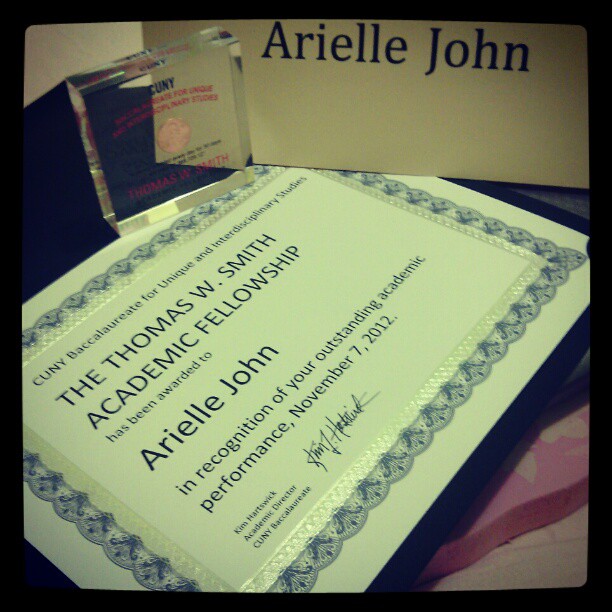
By the grace and mercy of God, I was able to come by four scholarships from CUNY and Brooklyn College for a number of things including academic merit, activism and a fellowship for travel. These awards still do not completely pay for school (or even remotely so) but they have been essential to my being able to complete my studies and not have me drop out of school and go back home. God knows I need these things to survive in this country, and has made a way where there was none. These are my parents prayers in tangible form.


1. South Africa (duh!)
Being able to finally travel to SA to be with Ryan and to spend time at the Market Theatre Lab was everything I needed to know that God is in charge of my life and that he is the grantor of prayers and dreams. 2013 makes it four years that Ryan and I have been journeying together and it is with increased faith and strength that I have been able to live and be fulfilled by this love and this commitment. The opportunity arose, the chance was seized and it was just crazy how everything fell into place and with precision. God is in charge and I can only wait to see what beauty he has in store for us in the upcoming year.


The self-sufficiency and independence that 2012 had been able to teach me has surely been making me into the kind of warrior my ancestors had been hoping for me to become. The kind of revelations God has been giving me in the creation of this show and the encouragement of those around me has led me to believe that 2013 is going to be one for the archives. I have many people that I thank God for whose presence in my life has surely been essential to my growth, both home and abroad (wherever those two places are to me now). They have all been light and know who they are.

Praise the seed, praise the womb of things, praise the anticipate. 
2013.


Monday, December 3, 2012

How to Wear a Problem.

Stephanie at work

A friend came over yesterday and almost immediately picked up the big bowl of earrings I keep on my dresser and started arranging them in pairs. In going through the stories and places of where they came from, we had somehow started talking about the spirit world, and travelling, and how spirits travel.

Even though the latter bit was unrelated to the jewelry itself, I remembered growing up that whenever I received wearable gifts from Africa or India, my mother would give me the bottle of holy water and explain that I should bless them and pray on them before I even try them out. Not really thinking about it until yesterday, I've realized how conditioned we have been towards our darker skinned origins, how colonialism has solidified for us what is pure and what is unclean.

embodiment through ritual mask

Of all the objects in my Trinidadian home, at least a quarter of them are made in China, we do not bless the new plastic mug before we make juice in it. We do not bless our Brazillian shoes from Ate logo. We have over and over been part and victim of the demonization of the same traditions that allow us to be here. I understand that spirits occupy things, if so, bless all the British printed books on the shelf that are quietly occupying your home, particularly the ones that have the effect of embodying lies surrounding your ancestors, for that of all, must be one of the most evil spirits that can exist in a thing. Bless everything in sight then.

This must also extend to my philosophy on thrift stores and wearing the second-hand clothes of strangers. I do not believe in embodying someone I have not known. Clothing is a most personal affair, something that touches the skin, is exposed to the sweat, the sweat being something inside of you that comes to the surface, something about that is way too spiritual for me to walk into a store and buy a top for $5 that can house some ghost that I am not trying to entertain. Friends and family, maybe. Vintage stores, not so much.

As much as the things we wear are external fixes, the fault of Adam and Eve, and the effects of a material world , their personality seems to be something that connects to deeper ideas about ourselves and other people.

Wednesday, November 21, 2012

God Bless the Child That's Got His Own.... Or Not Quite.


He has a brown bag with a 40's bottle to his mouth and is shouting at anybody who would listen "My life sucks, but I love it, it's the only one I got!". The 40-something year old broken record of a Chicano on Church Avenue, repeats his sentence as though he himself acknowledges the poetry of it, and is satisfied with how concisely he has been able to describe his life in the brief open narrative. I have been paying more attention to the homeless people in my neighborhood in recent months, and the fact that I see these very specific people at least four times a week, has made them a troubling part of my environment.

There is the young man with the black and red jacket, and the nike's to match, exposing his bone at the ankle. The story is that his mother lives on my street corner and she put him out because of drugs. On average twice a month he calls out to me and laughs with a sustained giggle when I don't respond to him. Honestly, I am afraid of him, since I see him at least once a day and he does not say much. I have understood that the quiet ones are those who purge in the most radical of ways, and usually avoid him when I can.

There is the man with the balding scalp who asks only for dollar bills. The fear I have for him is different. I have seen him everywhere, which is unlike this city. You barely see the same people twice. I have seen him at three restaurants in my neighborhood, just outside my campus, once inside the grocery and one evening on the train. All within the space of three months. He has a very personalized way in asking for money and I started wondering at one time if he actually knows my face and targets me. Bell Hooks in her discussion of Performance Practice as a Site of Opposition mentions "the notion of manipulative performance for survival". He begs so discreetly that you think it is a private matter between you and him alone, which has some type of emotional effect on the way people generally respond to him.

Hooks explains that these homeless people "are possessed spirits. In another culture- not a while supremacist, capitalist, patriarchal nation- their words might be listened to, their wisdom heeded." This sentiment reminded me very much of an experience Ryan and I had in the Eastern Cape, while waiting for our fifteen hour bus-ride back to Joburg. This old homeless man came up to us, speaking as much English as he could extract, and asks Ryan for money. Upon receipt of a few rand, he proceeds to give us advice for our relationship, and the importance of fidelity. He had approached only us out of the group of people there, and spoke at length on how we should live our married life. He ends his spiel by talking about Barcelona and Manchester United football teams with Ryan. It was as though with the transaction he felt indebted to us in some way and worked to compensate with his story. The old man walked a few steps up the street and it was as though he disappeared completely. We scanned the area for him a mere thirty seconds after he left us, and he was nowhere in sight.

All these examples tie into an internal conflict of wanting to engage people but being afraid of what they are capable of. I would even add that my being a woman has mostly raised my perceived risk level, these are people who are still out on the street when I am walking home late at night. I cannot be naive about the city and its monsters. But, what if they are not the monsters? And which one of them is Christ? I am caught daily wanting to help people, but I have never before been so aware of death and violence as probability since I moved to Brooklyn. My thoughts for now have been laid out, but not finished.

Also, this has been a wonderful project in Trinidad that works to capture the stories of the homeless, please check it out:
https://www.facebook.com/StreetLifeTnT


  • Let's Get It On: The Politics of Black Performance Edited by Catherine Ugwu Bay Press 1995

Sunday, November 11, 2012

Trinidad James and The Gold Plated Embarassment


Coming after what seems to have been a national outcry by the socially conscious adult public of Trinidad and Tobago, (admittedly gauging mainly from intensely angry facebook posts in my newsfeed), there seems to be much disapproval on the identity politics surrounding Atlanta-based rapper 'Trinidad James'. The young man explains in a promotional interview that he hails from Port of Spain and Mt. Hope,Trinidad and left the island to come to America where he entered the second grade in elementary school (which would land him at about 6 or 7 years of age at the time).

He explains that he was raised by his mother and that he moved from Trinidad such a long time ago that he does not remember much, but recalls a few anecdotes such as a childhood friend, eating doubles and drinking his first coconut water. He expresses that he had conflicts within himself as to determining who he was and "finding" himself when he moved to the US. Surely I can vouch for him here and say this is not the easiest transition to make in one's life. He also admits here that by the 4th grade, he lost his accent.

The rapper has prospects of returning to the island and even wants to enter into the soca monarch 2k13 competition. What I have so far outlined is important for me because I am currently looking at the circular immigration process and developing something I have called the 'Cascadoo narrative' (more on this later). I would therefore venture to say that Trinidad James is now recognizing this dual consciousness within himself, however distasteful we might find his exploration of this world. He is trying to uncover a part of himself that "he cannot remember", but he identifies himself as something while standing on the outside of that very thing.

He is wanting to be a part of this world. He has named himself after the island, and in his debut music video "All Gold Everything" can be seen sporting Trinidad's national colors, much in the same way that American gangster culture uses particular colored bandannas to represent their clique affiliation. His cadence follows the usual Atlanta drawl while his language is interspersed with pieces of Trinidad dialect "all in my" can transition to "all in meh" as "jeh watch" to "jus watch". I would also argue that gold has traditionally been the Caribbean's precious metal of choice for exhibiting wealth, as opposed to the now popular American bling diamonds and platinum. As Caribbean people we all had at least one family member or neighbour with a gold tooth in their mouth in the 90s (or at present?).

Trinidad James is actually performing his confusion, and should not be blamed entirely for what he considers as a journey towards himself. Nuttal looks at a number of adjustment strategies employed by adolescent Caribbean youth who migrate to America and have listed them as:

a) conformity (individuals dislike themselves and admire members of the dominant culture), (b) dissonance (conflicts arise between individuals depreciating and appreciating feelings for themselves, views held by the majority culture and other minority groups, and their own personal feelings), (c) resistance and immersion (individuals begin to appreciate themselves, ethnocentric feelings emerge, and they begin to dislike the majority culture), (d) introspection (individuals explore and examine the reason for liking themselves or their group, and the ethnocentric basis for judging other minorities and the dominant culture), and (e) synergetic articulation and awareness (individuals begin to accept and respect different cultural values of other minority groups, the dominant culture, and their own; Nuttall et al., 1990).

In accordance with James' interview, he sounds like he went through a number of these stages at different times in his life and is now in a space where he accepts American culture as his own, but recognizes still that it is not the only thing he has. I think that we actually have no right to determine that he is not Trinidadian on the basis that we do not see ourselves in him. Actually, I think that we are so frightened by how much we see our country in him that it's easier to dismiss him as ridiculous and 'shameful' than engage the mirror he is offering us.

James is the primary school friend who disappears from school one day and never comes back and the teacher announces that "he went to America" (these children hardly ever say a formal goodbye to their class). James is the product of readjustment probably with a mother who had to work multiple jobs, provide for him and did not get the sit-down time with him when he got home from school. James has the same ancestors as I do and we are probably remotely related somehow. James wants to somehow be included in that world he was pulled from. James performs America because America (gangster rap et al.) is what has raised him, you cannot give what you do not have. James is an adaptation to his environment, leopard print fur and everything therein.

James is a product of neglect and lack of guidance. What he chooses to represent is his own conundrum and we cannot decide on its legitimacy because we do not like what we see.

Peace.


  • Mitchell N. Academic Achievement Among Caribbean Immigrant Adolescents: The Impact of Generational Status on Academic Self-Concept. Professional School Counseling [serial online]. February 2005;8(3):209-218. Available from: Academic Search Complete, Ipswich, MA. Accessed November 10, 2012.
  • Nuttall, E., DeLeon, B., & Valle, M. (1990). Best practices in considering cultural factors. In A. Thomas & J. Grimes (Eds.), Best practices in school psychology (pp. 219-233). Washington, DC: The National Association of School Psychologist, 35, 1061-1070.


Friday, November 2, 2012

Dia de Muertos

“Dia de muertos” at the Mexico-US Border in Mexicali BC Mexico border with Calexico CA US. 


My father was born in the La Seiva Road cemetery in the 1960s. I grew up with my parents reminding me on every late night visit to my grandmother's house that I should fear the living more than the dead. It is only after having moved to America that I've come to appreciate my own worldview and the traditions that influence it regarding death and the afterlife. I have only seen two funerals in operation since I've been here, and one day I remember asking my friends whether they themselves go to funerals. The answer was no, not really.

Over the two odd years of my being here, having a mother who has often found herself as lead cantor at funeral services at our church in Sangre Grande, she has sometimes had as many as three funerals in a week. Surely I would attribute this to a closer-knit society and Caribbean culture where death is something commemorated by the community. People still feel the need to pay respect to the deceased, or merely lend support to the grieving family. In America, bodies are kept at the parlor where they are stored, then eventually they may or may not do a short service of sorts, after which people go to look at the coffin in the cemetery but never see it descend into the ground.

My theory is that grieving is such a sophisticated and drawn-out process in my culture that we give time for the dead to make the transition and for the living to begin adjusting to the absence of this person who has passed away. We often have open-casket funeral viewing, the body is sometimes brought to the house of the deceased, we have bullhorns announcing the death in the community, we keep wakes every night, we have nine nights (of prayer) after the passing, and we keep a church service forty days after the death date. In America, very few (if any) of these practices exist, even within a Caribbean community like Brooklyn. In my mind, this possibly has a connection to Halloween culture and how the dead are often demonized as evil zombies in popular culture.

Also, I think that America is lost to the idea of the realms of life being connected and a shared space for the unborn, the born and the ancestors (dead). If this were the case I think the abortion debate would be less of an issue. This is surely not a Western route, but what has been interesting for me as a black Catholic is the idea of the 'communion of saints' where those who have gone before us await us in the kingdom. As for who exactly constitutes a 'saint' by the standards of the RC church and its minority of canonized non-white saints, that is another blog post. I would say that I have been shaped by both West African philosophy and Catholic theology, which are not necessarily at loggerheads with each other. What these two things surely exclude is the limiting American (western) ideology that we belong to the present living state and that only.

I dreamt my grandmother last night. She was preparing to die but wanted us to comb her hair properly with a jeweled pin in her braid before she left this world. She said that she needed to be ready for the next. Bless her soul.

and may the souls of the faithful departed though the mercy of God rest in peace. Amen.


Thursday, September 27, 2012

Beulah, full of grace.


My aunt is light on her feet, more of a floating spirit than human. The single thing anchoring her is a dark stone medallion with the Virgin Mary, the one where she is all Chicana in a star studded robe, hands at chest-center looking like she just finished the sun salutation yoga pose. She was in the side room and appeared to me while scanning the last version of the New York times. We end up talking about working, and not working, and employment and what the procedure was like when she first left Trinidad to come here. One had to call in, and apply over the phone. "Now they want to see everything on paper" she says.

She is a number of shades lighter than I am with naturally straight hair, but has a story about 'us black people' having to find work here in the 1970s. She explains in her simple linen white shirt and loose mint green pants that on the trains, white people would not ever sit next to blacks, and she muses on how much she has seen the world change in front of her. By now her eyes are more alive than I have ever seen, but her mouth moves with a certain composure, she is fully engaged in the memory of the thing and tells me that God is leveling the world.

She says that people are intermarrying, living in the same communities together, certain animals are becoming extinct, certain animals are coming into existence, some plants are growing smaller while smaller plants are growing larger. She is explaining that an equilibrium is being established in the world. Not that I had expected  any marxist theology from the meagre bodied woman in a chemotherapy suite, but she says all these things with a collection and wisdom in her voice that I cannot doubt.

She mentions that the name 'Beddoe' that we came from was a well-known family name in Trinidad, that we were all related. She says that now it's like the name has been married out of us. We have enough girl children to show for it all. She used to paint things, beautiful things. She also wants to teach me graphology because she thinks the art is about to die. She says that God is coming soon, and floats back into the file room.